The Fractal Multiverse — a Theocentric Paradigm
What if the cosmos (Greek: “the ordered”) is indeed no accident, but a concentric cell — with a central radiation source (the “Black Sun”), orbited by seven planets and enclosed within the Earth shell — the cosmic egg?
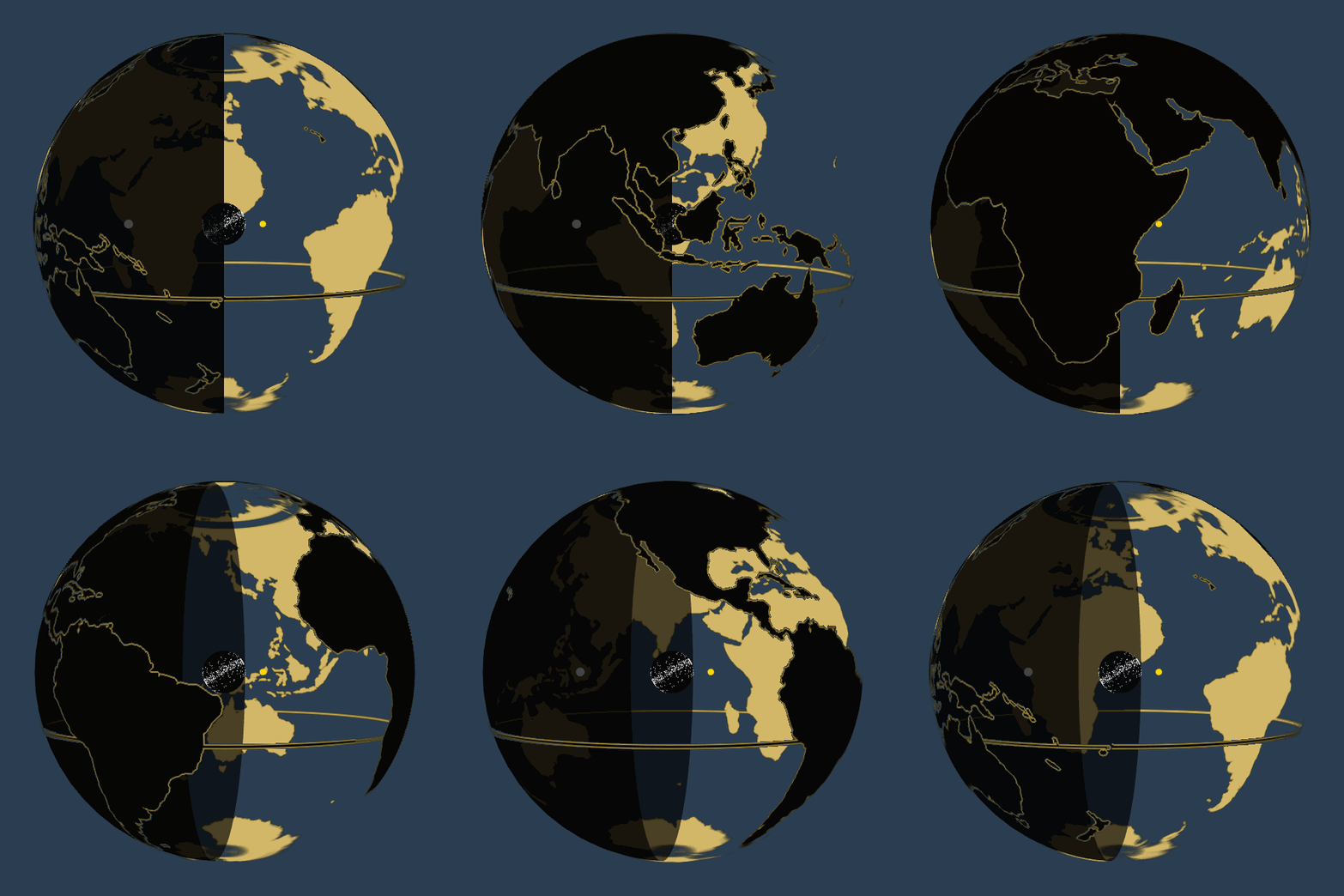
This famous quote represents today’s prevailing view. Yet even Pascal was wrong! A multiverse has no single centre and no boundary, but each of its infinitely many egg-universes has a clearly defined centre and “circumference” (shell).
Nine chapters exploring the cellular cosmos from history, physics, and philosophy
Cellular Cosmology (German: Zellularkosmologie) holds that we live on the inner surface of a self-contained cosmic cell. Light is curved by a radial aether gradient, producing merely the optical illusion of an all-encompassing sky.
The cosmic egg is already known from Vedic, Platonic, Norse, Kabbalistic, and Islamic traditions (Light Verse An noor). Rigorous application of logic and physics, together with AI-assisted modelling, make this model scientifically viable. It resolves many contradictions — from tides, geothermal heat, seasons, and the three-body problem to the theories of light and gravity.
The cosmic cell is the largest unit. Just as the body is composed of countless cells, the multiverse itself is cellular-fractal in structure. The universal egg structure repeats at both the macrocosmic and the microscopic scale.
The “Copernican revolution” displaced humanity and God from the centre of creation. Cellular Cosmology restores them — not out of anthropocentric vanity, but out of existential necessity. For absolute values like truth, beauty, and goodness require an Absolute, a Transcendent — a centre.
Worldview ≡ Self-image ≡ Image of God.
 Cellular Cosmology