 Cellular Cosmology
The Nature of Gravitation
In the cellular cosmos, gravitation is not a mysterious attractive force that pulls masses together across empty space. It is a push force — the result of an omnidirectional flux of ultramundane particles that are partially absorbed by matter.
Le Sage's Kinetic Theory of Gravitation
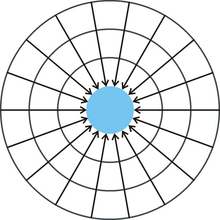
Georges-Louis Le Sage (1748) proposed that space is filled with tiny, fast-moving particles (corpuscules ultramondains) that stream in all directions. When two massive bodies are near each other, each shadows the other from part of this flux, creating a net inward pressure — what we perceive as gravitational attraction.
This theory elegantly explains: - The distance law (geometric shadowing) - Why gravitation is always attractive (shadowing can only reduce the flux) - Why gravitation is proportional to mass (more mass = more shadowing) - Why gravitation cannot be shielded (the flux penetrates all matter, is only partially absorbed)
Why Gravitation Cannot Be a Radial Pull Force
In the Standard Model, gravitation is a radial attractive force directed toward the center of mass. But this creates fundamental problems:
- No mechanism: How does mass "pull" other mass across empty space? Newton himself called this "such a great absurdity."
- Infinite speed: Gravitational effects appear to propagate instantaneously (Laplace), which contradicts the speed of light limit.
- Energy source: An eternal attractive force requires an energy source — where does it come from?
Le Sage's push gravity solves all three problems.
Continue to Chapter 8: Worldview · Self-Image · Image of God →
Antigravitation
Antigravitation Explained
About pressure radiation, forgotten physicists and the mystery of Coral Castle — a contribution to Cellular Cosmology
Gravitation is considered the best understood fundamental force of nature. Newton described it mathematically with a precision that is still used in space travel today. Einstein refined the picture to spacetime curvature. Nevertheless, none of these theories has ever answered how gravitation actually works — through which physical mechanism one mass acts on another without touching it, without a medium, across arbitrary distances.
Newton already recognized this problem in 1692 in a letter to Richard Bentley:
"That one body may act upon another at a distance through a vacuum, without the mediation of anything else, by and through which their action and force may be conveyed from one to the other, is to me so great an absurdity that I believe no man who has in philosophical matters a competent faculty of thinking can ever fall into it."
Newton's "Hypotheses non fingo" was not modesty, but conscious boundary-drawing: He described the behavior, not the cause. The mechanism remained open and is so to this day.
Attraction is not a physical term
Everyday language leads to a dangerous simplification: gravitation "attracts". But attraction is no physical explanation — it is a phenomenological description. A vacuum cleaner doesn't "suck" dust either, but creates negative pressure, while the higher air pressure behind pushes the dust into the tube. The mechanism is pressure — not pull.
Anyone standing on a scale measures a permanent, static force. This permanently transfers momentum. In all the rest of physics, the rule applies: force is momentum transfer per time. Momentum comes from somewhere — from particles, waves, a medium. Standard physics has no answer for the static gravitational force: Neither Newton's action at a distance nor Einstein's spacetime curvature describes a mechanism.
Le Sage and the shadowing principle
The Geneva physicist Georges-Louis Le Sage (1724–1803) postulated an omnipresent bombardment of tiny particles — corpuscules ultramondains — that penetrate space in all directions. A single mass is hit uniformly from all sides: no net pressure. But two masses shadow each other. The sides facing each other receive less particle stream than the ones facing away. This pressure difference drives the masses toward each other.
The model automatically delivers the 1/r² law from sphere geometry: The radiation distributes over growing sphere surfaces that increase with r². The force density decreases accordingly, exactly like light intensity with distance.
Maxwell and Kelvin rejected Le Sage's approach because of overheating: Absorbed particles would heat matter to unobservable temperatures in astronomically short time. However, this objection only refutes a specific additional assumption — that the particles are absorbed. With elastic scattering or an energetically open system, the problem disappears.
In Cellular Cosmology, the system is open: Energy is continuously input from the cell nucleus, flows through the cell and leaves it as Earth's heat. The overheating problem resolves in the flow-through model.
Gravitation as pressure gradient
The cell nucleus is the singular radiation source. aether particles flow from the nucleus to the periphery. At the shell, part is reflected and runs counter to the outflowing stream.
The result is a pressure gradient: From the nucleus outward acts forward pressure, from the periphery inward back-radiation. The closer an object is to the nucleus, the more back-radiation hits it — the gradient (the gravity) becomes smaller. What we experience as gravity is the difference between forward pressure and back-radiation, which decreases with 1/r².
What we measure as "weight" is the radiation pressure from the nucleus that pushes us against the shell, and the counter-pressure of the shell. Weightlessness in orbit is pressure equilibrium: forward pressure and back-radiation balance out.
Antigravitation: The funnel diode
If gravitation is a pressure gradient, then antigravitation is its reversal through geometry. A funnel in an isotropic particle stream acts as a pressure diode: Particles hitting the wide opening bounce off the walls and transfer much momentum. Particles on the tip find hardly any wall — they pass almost unhindered. The net pressure is asymmetric: The funnel is pushed toward the tip.
https://gorgeous-sundae-6b1833.netlify.app/
This simulation shows quantitatively: The momentum transfer from the wide opening is systematically larger than from the tip. The net force points permanently toward the tip — emergent, without predetermined direction.
A deformed atomic nucleus with quadrupole moment acts as a microscopic funnel in the aether stream. If all nuclei are coherently aligned, these asymmetries sum to a macroscopic diode effect — the body experiences a net pressure against the gravitational direction.
Coral Castle and the long horns of the monks
Edward Leedskalnin built between 1923 and 1951 in Florida alone a monument of coral rock — the Coral Castle. Individual blocks weigh up to 30 tons. Eyewitnesses reported he connected funnel-shaped devices via cable to a box and thus made stones weightless.
Similar reports are handed down from Tibet: Monks are said to have created a resonance point on rocks in a semicircle with long horns and drums, which made these weightless.
Both share focused sound geometry. The funnel focuses sound energy at the focal point, the semicircle of horns creates coherent superposition in the focus. There arises highly coherent longitudinal oscillation — pressure waves that act mechanically on atomic nuclei. With sufficient intensity and correct frequency, this oscillation aligns the nuclear moments coherently, analogous to nuclear magnetic resonance, only acoustically driven.
The crucial condition is vertical alignment with the funnel axis pointing upward. Then the nuclei act as a macroscopic pressure diode against the gravitational direction. Leedskalnin's "box" was presumably a frequency generator to search for the resonance frequency of the rock.
The Tibetans used low frequencies — a few dozen hertz. Low frequencies have long wavelengths, penetrate matter deeply and couple mechanically more strongly to the crystal lattice.
Mechanism of antigravitation
Standard physics knows aligned atomic nuclei, but no reason for their gravitational relevance, since gravitation there only couples to mass, not to orientation.
In the pressure model of Cellular Cosmology, this reason emerges compellingly: If gravitation is a directional phenomenon — a pressure gradient — then the geometric orientation of the scattering bodies is directly gravitation-relevant. Coherently aligned atomic nuclei brake the aether stream from the gravitational direction more strongly than the oncoming one. The pressure gradient reverses — the body is pushed upward.
Antigravitation is thus no mystical force, but rectification of gravitation through geometry. A mechanism that Leedskalnin and Tibetan monks possibly discovered empirically, long before the theoretical framework.
Gravity Power Plant
The world's first "gravity power plant" (or "capillary power plant") with over 100% efficiency was invented by the Munich philanthropist Hans Weidenbusch. It is patent pending, cheap, maintenance-free, environmentally friendly, scalable. This would solve humanity's energy problem. Once again?
Capillary Effect (Capillary Action)
"Liquids rise in narrow tubes against gravity. The finer the tube and the surface tension, the greater the rise height. The capillary effect arises from the interaction of cohesion/cohesive force between the molecules of a substance (liquid) and the adhesion/adhesive force between the molecules of different substances (liquid/inner wall of the tube)."
The smaller the diameter, the greater the capillary pressure and rise height. In a capillary of 2 µm diameter (1 µm radius), according to the formula below, the rise height of wetting water is 14 meters and the capillary pressure is 1.4 bar. Wikipedia
The rise height h of a liquid column is given by:
{\displaystyle h={{2\sigma \cos {\theta }} \over {\rho gr}}} Where:
{\displaystyle \sigma } = Surface tensionθ = Contact angleρ = Density of the liquidg = Gravitational accelerationr = Radius of the tube
Capillary effect as a function of pipe cross-section
Minimalist Power Plant Design without Float?
Would the ultimate, fluid form without floats or other moving parts (except for the paddle wheel) work? Can a permanent compensating movement be set in motion by short-circuiting the gravity differential potential between right and left sides? Due to capillary forces, which are known to counteract gravity rather than enhance it (otherwise no tree could hold its capillary saps - independent of the respiratory cycle), a part of the water mass on the right is held "in suspension" (as if with upward-pointing barbs). However, this reduces the resulting total weight of the right water mass, the back pressure to the right would have to be stronger than that to the left. Consequently, a cycle should begin, since not a single drop can be displaced for pressure equalization from left to right without one flowing back in return. Where is the logical error? Answer: The internal resistance of the capillary is many times greater than the hydrostatic pressure of the non-capillary corresponding liquid quantity, independent of the gravity-neutralizing adhesive force! The water molecules are virtually chained to the walls, but do not climb higher than the walls! So no more pushes from below than would be necessary for wetting.
The liquid rises due to adhesive forces to the wall of the tube and thus only to its end, even if the capillarity would allow a greater rise height. - Capillarity
The Cohesion Theory of Water Transport
What gigantic force always pulls new water from the roots upward in the tree? When the capillary is full and something evaporates at the top (via leaf pores), how does the "suction" reaching down to the roots occur? Shouldn't there be at least - like in a traffic jam - a pulsating rather than a continuous flow?
"If one additionally assumes high air pressure that pushes the water column further into the capillary, a rise height of 10 meters can be achieved with thin capillaries. However, CAPILLARY FORCES are BY FAR not sufficient as an explanation for water transport in trees. ... Through the COHESION of water molecules (cohesive forces), the SUCTION generated by water release acts not only on immediately adjacent molecules, but on the ENTIRE WATER COLUMN in the water-conducting pathways of the vascular bundles (xylem) down to the root and thus always maintains a compact water column."
This is exactly the same argument as with the human heart, whose pumping power is never sufficient to press blood through the capillaries. The vessels themselves would have to "co-pump" (vascular peristalsis), but this has also been disproven. So science also faces a puzzle when confronted with a 30 m tall tree.
Enlightenment is more important than savings
Who wants progress and who wants to prevent it?
"There will be reactionaries tomorrow too!" - Hans Weidenbusch
It's not about a few billion here or there! Humanity has allowed itself to be fleeced long enough because it let self-appointed experts prevent it from thinking for itself. Even more important than free energy supply for the individual is a broad societal discussion and clarification of concepts to clarify the battle lines.
Additional Patents for Buoyancy Power Plants
Buoyancy power plant according to Guillaume, 1928 Belgium Pat. No. 359840
Where is Guillaume's error ? One can increase the height of the buoyancy container arbitrarily to really overcompensate for all possible friction losses. And a force actually acts (gravitational force of the displaced liquid) on the chain, while on the other side only gravity opposes it. The problem is the displacement work for the bottom buoy so it can actually enter the buoyancy basin. Here one might need to construct a watertight lock to reduce the pressure. The buoys should then have no contact but would have to push each other. But above all, due to the size, we probably have no gravity-reducing capillary effect anymore!
Is a Capillary Power Plant a Perpetual Motion Machine?
A perpetual motion machine of the first kind is a machine that contradicts the law of conservation of energy (analogous to the 1st law of thermodynamics). It should provide at least the energy necessary for its own operation and in some cases additional useful energy. Such a machine would create energy from nothing and thus contradict the law of conservation of energy. Examples:
A water wheel pumps water upward. Part of the water flows down again and drives the water wheel.
(Definition from https://de.wikipedia.org/wiki/Perpetuum_mobile)
Wait! We simply replace the water wheel with a capillary bundle . The capillary effect is a natural pump that runs continuously as long as water can flow through! Not part, but all the water then flows down again through the "gravity effect" and refills the capillaries anew. Does this contradict the law of conservation of energy?
The law of conservation of energy expresses the empirical fact that energy is a conserved quantity, that is, the total energy of a closed system does not change with time. Energy can indeed be converted between different forms of energy, for example from kinetic energy to thermal energy. Energy can also be transported out of or into a system. However, it is not possible to create or destroy energy. Energy conservation is considered an important principle of all natural sciences.
(Definition from https://de.wikipedia.org/wiki/Energieerhaltungssatz)
That's right: the law of conservation of energy expresses an "empirical fact"! But gravity and capillary force are also "empirical facts"! And restrictively, the law of conservation of energy also only refers to a "closed system".
A closed system is a system without interaction with its environment.
(Definition from https://de.wikipedia.org/wiki/Abgeschlossenes_System)
But we have an"interaction with the environment", namely gravity, which actsrepeatedly anewon the water that is pulled upward (in the capillaries by molecular forcesagainstgravity)!
The capillary power plant is therefore not a perpetual motion machine because it is not a closed system! Through asymmetric coupling, the two opposing forces (gravity and capillary force) are short-circuited and repeatedly converted into kinetic energy.
In principle, the capillary power plant behaves exactly like a windmill: This is driven by wind (water) created by an air pressure differential (gravity differential).
It is not even necessary to understand whether gravity is static or dynamic. One also says that a magnetic field is not dynamic. But then one should not speak of forces. The previous inability to use these forces for permanent energy generation (the law of conservation of energy is only an empirical law!), is of course no proof that one cannot use them in the future (through rectification).
In an interview with Hans Weidenbusch, he explains how difficult it is to market a perpetual motion machine. It encounters criminal resistance from hacker-activists who must profile themselves as worldview defenders.
Comments
Loading comments...