 Cellular Cosmology
Construction of the Cellular Cosmos
How is the cellular cosmos geometrically constructed? This chapter presents the mathematical and geometric foundations.
Inversion at the Unit Circle
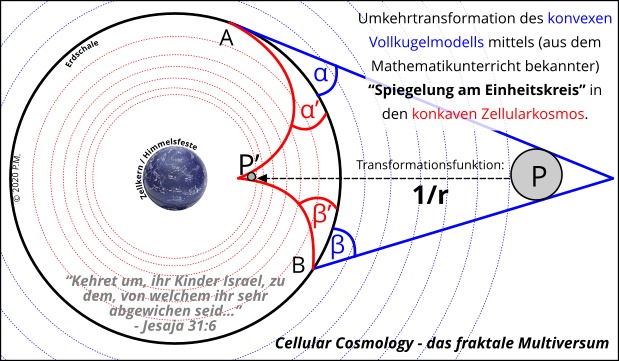
The key mathematical operation is circle inversion (Kelvin transformation): every point outside the unit circle maps to a point inside, and vice versa. What appears as infinite outer space in the Copernican model maps to a finite inner space in the cellular model.
The Sun, at apparent distance of 150 million km in the convex model, maps to a compact luminous core near the centre of the cell. The "infinite" universe becomes a bounded sphere.
The Aether Gradient and the Cardioid
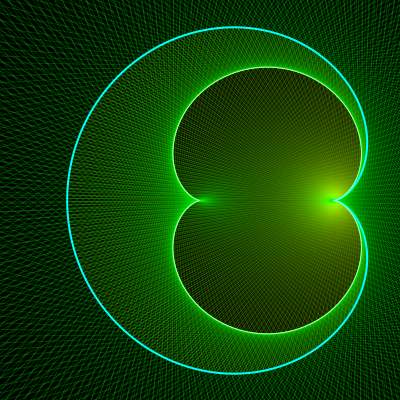
Light propagation in the cellular cosmos follows curved paths due to a radial gradient in aether density. The density increases towards the centre, causing light to bend inward — analogous to Snell's law in optics.
The resulting light paths trace cardioid curves, producing the optical illusion of a convex Earth in infinite space for an observer on the concave inner surface.
The Golden Ratio and Master Measure
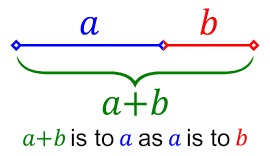
The construction of the cellular cosmos follows the golden ratio (φ ≈ 1.618). The proportions between the shell, the habitable zone, and the luminous core reflect this fundamental ratio — the same ratio found in spiral galaxies, DNA helices, and the human body.
The 23° Axial Tilt
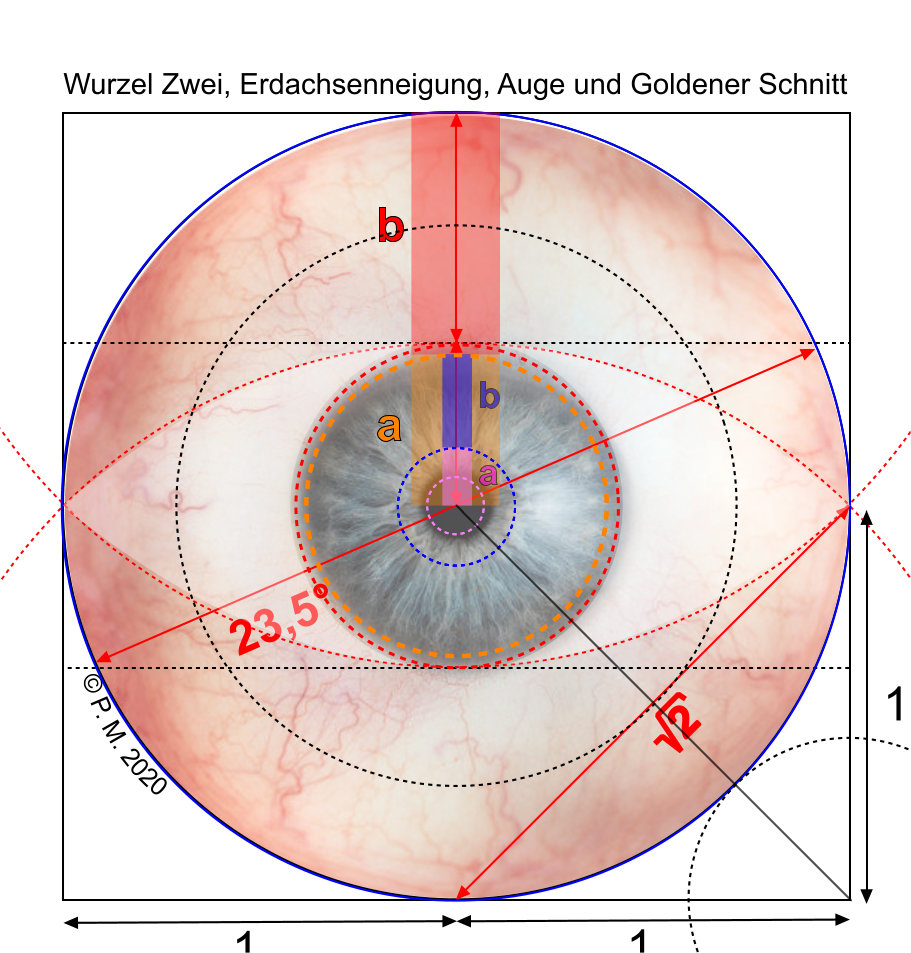
The 23.4° axial tilt of the Earth's rotation axis (in the standard model) corresponds to the tilt of the central light source's orbital plane in the cellular model. This tilt produces the seasons and is geometrically related to the construction angle of the cosmic cell.
Continue to Chapter 5: Copernican Critique →
Comments
Loading comments...