 Cellular Cosmology
Physical Evidence
Beyond historical tradition, several physical observations can be explained more naturally by a concentric cosmology than by the standard model.
The Distance Law and the Sun's Position
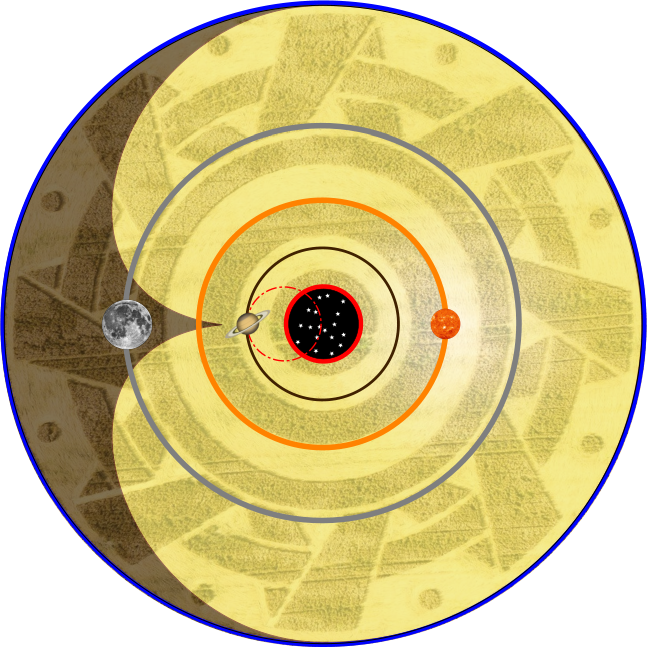
The intensity difference between morning and midday sun follows a distance law that is consistent with a radially varying aether density — and difficult to reconcile with a uniformly illuminated convex surface at a distance of 150 million km from the source.
Spring Tides at New and Full Moon
In the cellular model, sun and moon occupy opposing positions relative to the central axis. Their alignment at new moon (conjunction) and full moon (opposition) generates maximum tidal forces — a geometric consequence of concentric orbital mechanics.
The Blood Moon
During a lunar eclipse, the moon turns deep red. Standard theory attributes this to atmospheric refraction. In the Cellular Cosmology model, the red coloration is a natural consequence of light passage through the denser inner layers of the aether gradient — the same mechanism that produces red sunsets.
The Gegenschein
A faint light spot at the antisolar point in the night sky. In the standard model, this requires backscattered sunlight from interplanetary dust. In the Cellular Cosmology model, it is simply light from the central source, refracted through the aether gradient — a natural optical caustic.
Electromagnetic Wave Propagation
The frequency-dependent range of electromagnetic waves (VLF waves propagate further than VHF) is consistent with a curved propagation medium — exactly what a radial aether gradient would produce.
Continue to Chapter 4: Construction →
Symbolism of Eclipses
On the Symbolism of Solar Eclipse and Lunar Eclipse
Solar Eclipse as Cosmic Transgression
In the Vedic tradition, the solar eclipse is symbolized as the swallowing of the sun by the shadow planet Rahu - one of the three astrological malefics alongside Mars and Saturn. This representation emphasizes the negative quality of the event, although the physical phenomenon is caused by the moon.
The occultist interpretation sees in the solar eclipse the union of masculine (sun) and feminine (moon). Cosmologically, however, both celestial bodies stand as siblings alongside each other:
God made the two great lights, the greater to rule the day, the smaller to rule the night, also the stars. - Genesis 1:16
The similarity of "Sun" (sun) and "Son" (son) clarifies that the sun is not to be understood as father, but as son. The true father is the invisible "Black Sun", the central fire:
Below the upper, above the lower is he [the Sun] who knows his father. - Rig Veda I.164/18
This kinship structure - with the father above sun and moon and the earth as mother - makes the solar eclipse the unnatural union of siblings, a symbol for incest and transgression against the cosmic order.
Empirical Evidence of Negative Effects
A Russian experiment showed that tissue samples began to wither a week before a solar eclipse. This negative effect is known to indigenous peoples like the Venezuelan Panare Indians, whose language uses the same word for solar eclipse and incest: towömuku.
Ethnographic studies confirm this connection:
The word towömuku, which means both "eclipse" and "incest," is revealing... solar eclipse is linguistically expressed as renewed sexual intercourse of these two celestial bodies... While these epidemics have a supernatural cause, they have the most terrible of natural consequences: the death of many individuals. - Under the Rainbow: Nature and Supernature among the Panare Indians
The Covered Eye of Re
In ancient Egypt, the eyes were assigned to sun (right eye of Re) and moon (left eye of Horus). Goethe, as an initiate, formulated this connection:
Were the eye not sun-like, it could never behold the sun; if God's own power did not dwell within us, how could the divine delight us? - J. W. v. Goethe, "Zahme Xenien"
The modern symbol of the covered right eye refers to the overshadowed sun and thus to the transgression against divine order. The right eye of Re symbolizes:
- Sun and intellect
- Threatening annihilation
- Punishment through plagues
- The wrathful solar deities Re, Amun-Re, Re-Harakhte, Aton
During the solar eclipse, Re can also appear as Nibiru - surrounded by uraeus serpents representing high-frequency electromagnetic discharges.
Eucharistic Parallels
The Catholic Eucharist shows remarkable parallels: With "Hoc est corpus Meus - this is my body" the host is declared the solar body, and through "eat of it" the incorporation of the sun occurs - analogous to the mythical swallowing by Rahu. Ironically, "hocus-pocus" (false magic) derives from this transubstantiation formula.
Biblical Incest Motifs
The Bible knows several incest stories: Lot and his daughters, as well as according to old theories a possible half-sibling marriage between Jesus and Mary Magdalene, which would have been forbidden under Jewish law.
Protective Measures During Solar Eclipse
In the Indian tradition, strict behavioral rules apply during a solar eclipse, as it is considered contamination:
Many people believe that during an eclipse, the earth is plunged into darkness, which is a negative force. As a result, one must pray for the duration of the eclipse, and take a bath afterwards. - Indiaparenting
Water pots must be emptied, as the water is considered impure. These traditions reflect the understanding that solar eclipses facilitate light-shunning forces' access to the earthly plane.
Lunar Eclipse as Blood Moon
The lunar eclipse differs fundamentally from the solar eclipse. Here the full moon is swallowed in the "night channel" of Rahu. The moon symbolizes the mind and emotions. In the reddish discoloration of the blood moon "the intellect sees red" - a symbol for the moment when rational control fails and destructive frenzy becomes possible.
Both eclipse types are therefore considered negative cosmic events that represent fundamental disturbances of the natural and spiritual order.
Tides Through Radiation
Proof: Tides Are Created by Radiation, Not by Gravitation
The mainstream physics explanation of tides contains fundamental contradictions. A simple change in the force sign - assuming a pushing radiation instead of an attracting "space curvature" - resolves these inconsistencies.
Refutation of "Attractive Force"
The term "attractive force" is fundamentally wrong. There are no particles with "fishing lines," and "space curvature" does not explain why masses move toward each other. With pressure and underpressure, however, the matter becomes immediately clear.
Obvious Observations
- Two opposing tidal bulges form on the Earth's surface
- The mean high water interval against the Moon's passage through the prime meridian is 6 hours for many neighboring locations
- The greatest tidal heights are reached near the poles (up to 13 m) and not at the equator (up to 1.5 m)
- The Sun has 46% of the Moon's tidal force
- Spring tide occurs both at new moon and at full moon
- Neap tide occurs at quadrature of Sun and Moon (90° angle relative to Earth)
- Dry "moon wood" is obtained at new moon
Official Theory
- Tides are caused by attractive forces of Moon and Sun
- The tidal bulge away from the Moon is created by centrifugal force due to an "imbalance of the Earth/Moon system"
- Spring tide is created by addition of forces of Sun and Moon in conjunction or opposition
Obvious Contradictions
- Why do we have two approximately equal-sized tidal bulges?
- Why doesn't the tide create the highest tide level at zenith, but often only 6 hours later?
- Why are the tidal bulges much higher near the poles, although these are not directly below the zenith?
- How can an imbalance generate increased centrifugal force when the centrifugal forces remain the same at every point on Earth's surface?
- How can the resulting force vector have the same magnitude and direction in conjunction and opposition during spring tide?
- How can neap tide arise at a 90° angle?
- Why can dry moon wood only be obtained at new moon?
Alternative Radiation Pressure Theory
Instead of attraction, a pressure effect from Moon/Sun is assumed. Through this sign change, all contradictions are resolved:
- Two tidal bulges ("water edges") always form
- The mean high water interval is 6 hours because low tide prevails at the sublunar point and the tidal bulges follow offset by 90°
- The strongest pressure force (ebb effect) occurs directly below the zenith near the equator
- The tidal forces add up in conjunction and opposition, since the pressure edges of Moon/Sun offset by 90° are congruent
- The neap tide at quadrature makes sense, since only then does the ebb effect of the Sun hit the tidal bulges of the Moon
- Dry moon wood at new moon: Sun and Moon intensify the PRESSURE downward into the roots
"Where the Moon presses strongest, i.e., on the straight connecting line, there is the lowest water level, i.e., low tide, and we have high tide on the edges of the respectively illuminated or irradiated hemisphere." - A. Minor, "Natural View and Worldview in the Year 1950", 1928
The Second Tidal Bulge
The animation of the Earth-Moon system clearly shows that no point is exposed to stronger centrifugal force. Alternative "explanations" are even more illogical:
"On the opposite side of Earth, the Moon's attraction is somewhat less than at Earth's center. Therefore, the water there loses the ground beneath it, so to speak, and the sea level rises."
This explanation surpasses the "imbalance variant" in illogic. The term "attraction" is problematic - in nature there are no particles with fishhooks and certainly no relativistic "space curvature."
Sun Has 179 Times Gravitational Force but Only 40% Tidal Force
The main argument against gravitation as the cause of tides:
"The fact that the Moon's force is more than double the Sun's, despite the fact that by the inverse square law the Sun's force should be 179 times the Moon's, is that the electric force is a function of charge, not mass." - Thunderbolts.info Forum
Timing for Dry "Moon Wood": New Moon
The Swiss researchers Ernst Zürcher and Rodolphe Schlaepfer showed that moon phase has a significant influence on germination behavior. Their studies proved that wood cut according to moon phase has different properties.
"The trees must be cut in winter around Christmas time during waning moon shortly before NEW MOON."
Explanation: Sun and Moon intensify the pressure downward into the roots - the trunk becomes drier.
Gravitation as Radiation Pressure
Le Sage's "push theory of gravitation" from 1756: Two bodies are not attracted but pushed toward each other by invisible particles. Between them, a "particle shadow" forms, creating fewer repelling particles.
This insight also explains inertia and relativistic mass increase as resistance of the particle stream against moving bodies.
Georg Christoph Lichtenberg wrote about Le Sage's theory in 1790:
"If it is a dream, then it is the greatest and most sublime that has ever been dreamed, and with which we can fill a gap in our books that can only be filled by a dream."
Specific Effect of Moon and Planets
Both celestial bodies possibly emit water-specific frequencies. The German chemist Lili Kolisko proved in the 1920s that each planet specifically affects its associated metal.
This is confirmed by laser experiments with material-specific optical levitation:
"Using laser radiation, optical levitation (free floating) of transparent, uniform dielectric particles could be realized. During light refraction, momentum transfer occurs, which is the cause of a force acting in the beam direction." - Spektrum.de
Consequence of the Radiation Pressure Thesis
If gravitational radiation presses uniformly radially-perpendicularly onto the sphere surface from all sides, a radiation center is absolutely necessary. This means that Earth's surface must be concave and not convex.
The avoidance of solving the gravitation question is due to the extreme implication for the worldview. The prevailing cosmology is without center, without focus - while a radiation pressure theory presupposes a central principle.
Solar Eclipse 1999
The "Prince of Terror" announced by Nostradamus does not visibly enter as a person, but symbolically takes the world stage on August 11 at exactly 11:11 AM [GMT; London] in the form of a total solar eclipse , whose umbra originates in the Atlantic Ocean and first touches the Earth over Tintagel (the birthplace of King Arthur in Cornwall, Wales). The eclipse is an occult symbol for Satan, or in this case the beast that "rises from the waters".
"In the year 1999 after Seven full months From the sky will come the Great King of Terror who will bring back the Great King of Angolmois Before and after this, shall Mars reign supreme" - Century X Quatrain 72
KING ANGOLMOIS = ANGLO [KING] + LION + SANG + SOLOMON Anglo = White, of British descent, from the word Angel Lion = Lineage of Judah/Christ; the coat of arms of England Sang = (French) 'Blood,' as in SanGraal or Holy Blood. The Grail Solomon = Son of King David; a descendant of the Messiah's bloodline The King Angolmois anagram was created by Nostradamus to encode the following meaning: "THE BLOOD[LINE] OF KING DAVID IS CONTAINED IN THE GREAT KING OF ANGLO-LAND (England).
"When the Eclipse of the Sun will then be The Beast's Omen will be seen in the daylight One will interpret it much different from the rest High price unguarded: many ill-prepared for it." - Century III Quatrain 34
Translation: "During the solar eclipse, the sign of the beast will be seen in broad daylight. One [the knowing one] will interpret it completely differently than all others. A high price [paid] by those who do not [protect themselves from the evil influence]. Many are [spiritually] clueless-poorly prepared [for the event and its meaning]." This solar eclipse over Tintagel is held by many occultists as the literal "moment of sowing for the spiritual birth of the New Messiah of Aquarius". It also stands for the rebirth of the King Arthur archetype . The last - and some say the most amazing - piece of evidence for the connection between solar eclipse and King Arthur / Prince William is the star Arcturus , which rose to exactly its highest point at the middle of the solar eclipse (around 11:11 AM) . Arcturus is also known as Satan's star . Also mentioned was the star Angol ( known as the demon star) and its relation to Prince William, the future King, who is born from the serpent. Another source states that the omen occurs exactly in the sign Leo (Satan). Nine months later, on May 5, 2000, a planetary conjunction formed the "New Star of Bethlehem" through a straight line of planets . More interesting than that was the way those same planets were perfectly aligned in the 12 Houses of the Zodiac for they foretold the return of a King. This King of Terror, or future King who will come from England, combined with the 11:11 symbology and it's Eclipse was ultimately to send a powerful portent to Satanists, even knowledgeable (Gnostic) Christians, telling them their long awaited 'Aquarian Age' has finally arrived and their ancient King has been reborn, meaning the spirit of Antichrist, ('the King who was') has arisen, and is soon to go into the Son of Perdition as prophesied. Just as Christ has His 12 disciples who were as '12 Astrological Planets revolving around their central Sun,' - the Antichrist will also have his 12 zodiacal personages placing him at center. These are his Ten subordinate Kings (or Knights), along with his False Prophet (11) and that of his Mother Goddess (12) which only adds to the Satanic interpretion of Revelation chapter 12 seen above which depicts a Woman having 12 stars above her head (...'and the Stars spell out your name..."; 12 lines to make D-I-A-N-A) who bears a Child beset upon 'God's Throne' who is to 'rule all nations'. Interestingly, the omen in Revelation 12 will literally play itself out in the western skies over Israel (over the Mediterranean sea) on March 29, 2006 during a Total Solar Eclipse of the Sun, with Virgo ('Woman clothed with the Sun, Moon under her feet') having in her belly the planet Venus (Child) with Mars (Red Dragon) awaiting nearby.
Hidden Sun Symbolism in the Mini Cooper Logo
At Prince William's birth there was a partial solar eclipse with Saros number 117.
"A partial solar eclipse occurred on 21 June 1982, the day of Prince William's birth. The eclipse reaches its maximum at exactly 12:03 UT (Universal Time), ie, while the summer solstice reaches its maximum. Exactly nine hours later, 21:03 UT birth of Prince William. Solar eclipse of June 21, 1982 belongs to a series of eclipses that have Sarosnumber 117th Saros". - Above Top Secret, 2011
See also Prince William's Vedic birth chart .
Comments
Loading comments...